
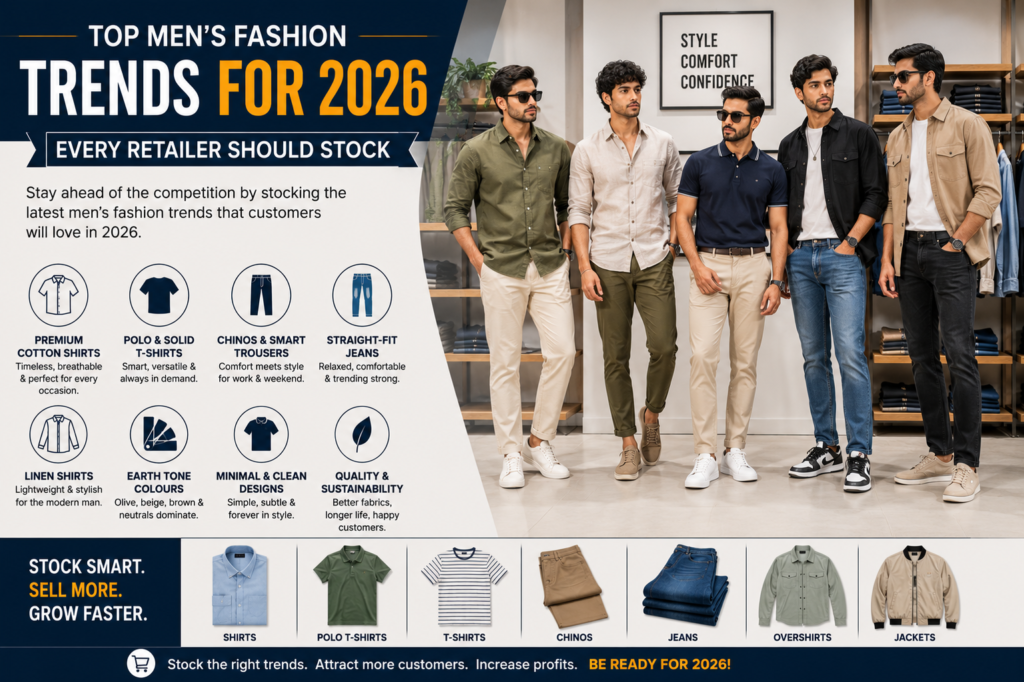
Fashion is constantly changing, and customer preferences evolve every season. What was popular a year ago may no longer attract buyers today. For clothing retailers, staying updated with the latest trends is not just about offering stylish products—it’s about keeping customers interested, increasing sales, and staying ahead of competitors.
As we move into 2026, men’s fashion is becoming more versatile, comfortable, and practical than ever before. Today’s customers want clothing that looks fashionable while also being suitable for work, casual outings, travel, and special occasions. They are looking for high-quality fabrics, modern fits, timeless colours, and clothing that offers value for money.
For retailers, understanding these changing preferences is essential. Stocking outdated styles can slow inventory turnover, while offering trending collections can attract new customers and encourage repeat purchases.
Whether you own a clothing store, supply garments to retailers, or operate an online fashion business, knowing the top men’s fashion trends for 2026 will help you make smarter purchasing decisions and maximise profits.
In this guide, we’ll explore the latest men’s fashion trends that retailers should stock in 2026, explain why these styles are becoming popular, and share practical tips on choosing inventory that sells throughout the year.
Contents
- 1 Why Following Fashion Trends Matters for Retailers
- 2 What Will Define Men’s Fashion in 2026?
- 3 Trend 1: Premium Cotton Shirts Will Continue to Dominate
- 4 Trend 2: Oversized and Relaxed-Fit Shirts
- 5 Trend 3: Linen Shirts for Summer Collections
- 6 Trend 4: Polo T-Shirts Continue Their Strong Growth
- 7 Trend 5: Earth-Tone Colours Will Dominate 2026
- 8 Trend 7: Chinos and Smart Casual Trousers Continue to Grow
- 9 Trend 8: Minimal Designs Will Outsell Loud Prints
- 10 Trend 9: Coordinated Outfit Collections Increase Sales
- 11 Trend 10: Customers Are Investing More in Quality Than Quantity
- 12 Buying Tips for Retailers Planning Their 2026 Inventory
- 13 Common Mistakes Retailers Should Avoid
- 14 Expert Advice from Vishal Clothing
- 15 Why Retailers Choose Vishal Clothing
- 16 Frequently Asked Questions
- 16.1 1. What are the biggest men’s fashion trends for 2026?
- 16.2 2. Which men’s clothing products should retailers stock in 2026?
- 16.3 3. Which colours are expected to be popular in men’s fashion during 2026?
- 16.4 4. Why should retailers follow fashion trends?
- 16.5 5. Where can retailers buy trending men’s fashion collections in Chennai?
- 17 Conclusion
Why Following Fashion Trends Matters for Retailers
Fashion trends are more than just changing colours or new designs. They directly influence what customers buy and how often they return to your store.
Imagine two clothing retailers operating in the same market.
The first retailer continues to stock outdated styles that were popular several years ago.
The second retailer regularly introduces fresh collections inspired by current fashion trends while maintaining classic best-selling items.
Which store will attract more customers?
Most shoppers are naturally drawn to stores that offer something new. They enjoy discovering fresh colours, updated fits, and seasonal collections. Even customers who usually buy basic clothing appreciate having modern options to choose from.
Keeping your inventory updated offers several advantages:
- Attracts new customers looking for current styles
- Encourages repeat purchases from existing customers
- Improves inventory turnover
- Increases average order value
- Strengthens your brand image
- Reduces slow-moving stock
The goal isn’t to replace every product each season. Instead, successful retailers balance timeless essentials with trending pieces that reflect changing customer preferences.
What Will Define Men’s Fashion in 2026?
Men’s fashion in 2026 focuses on three major ideas:
1. Comfort Comes First
Customers no longer want clothing that looks good but feels uncomfortable. Soft fabrics, relaxed fits, breathable materials, and lightweight garments are becoming the preferred choice for everyday wear.
Whether it’s a formal shirt or a casual T-shirt, comfort plays a major role in purchasing decisions.
2. Smart Casual Continues to Grow
The line between formal and casual clothing continues to blur.
Many professionals now work in flexible office environments where strict dress codes are less common. As a result, clothing that combines style with comfort is becoming increasingly popular.
Products such as polo T-shirts, chinos, premium cotton shirts, and smart casual trousers are expected to remain strong sellers throughout 2026.
3. Quality Over Quantity
Modern customers are becoming more selective. Instead of buying several low-quality garments, many prefer investing in fewer pieces that last longer and maintain their appearance after repeated use.
Retailers who stock durable, well-made clothing often experience higher customer satisfaction and more repeat business.
Trend 1: Premium Cotton Shirts Will Continue to Dominate
Cotton has always been one of the most trusted fabrics in men’s fashion, and its popularity will only grow in 2026.
Customers appreciate cotton because it is:
- Soft
- Breathable
- Comfortable
- Suitable for all-day wear
- Easy to maintain
Premium cotton shirts are ideal for office wear, business meetings, family functions, and casual occasions, making them one of the safest investments for retailers.
Best Colours to Stock
- White
- Sky Blue
- Navy Blue
- Olive Green
- Beige
- Black
- Light Grey
These colours appeal to a wide range of customers and remain in demand throughout the year.
Trend 2: Oversized and Relaxed-Fit Shirts
Slim-fit clothing dominated men’s fashion for many years. However, relaxed silhouettes continue to gain popularity, especially among younger buyers.
Oversized shirts offer:
- Greater comfort
- Modern appearance
- Easy layering
- Versatile styling
Retailers should include a balanced mix of relaxed-fit shirts alongside regular-fit options to cater to different customer preferences.
Popular choices include:
- Solid oversized shirts
- Striped shirts
- Checked overshirts
- Linen-blend relaxed shirts
Trend 3: Linen Shirts for Summer Collections
As temperatures rise across many parts of India, lightweight fabrics become increasingly popular.
Linen shirts are expected to remain one of the fastest-growing product categories in 2026 because they offer:
- Excellent breathability
- Natural texture
- Premium appearance
- Comfortable summer wear
Customers particularly prefer linen shirts for vacations, outdoor events, and casual office wear.
Retailers should stock colours such as:
- White
- Sand
- Olive
- Light Blue
- Pastel Green
These shades complement the relaxed nature of linen and appeal to modern consumers.
Trend 4: Polo T-Shirts Continue Their Strong Growth
Polo T-shirts have become one of the most versatile products in men’s wardrobes.
They are suitable for:
- Office
- Weekend outings
- Travel
- Casual meetings
- Family events
Unlike traditional round-neck T-shirts, polo T-shirts create a more polished appearance while remaining comfortable.
Retailers should consider stocking:
- Solid colours
- Minimal logo designs
- Textured fabrics
- Premium cotton polos
Best-selling colours include navy, black, white, maroon, bottle green, and charcoal grey.
Trend 5: Earth-Tone Colours Will Dominate 2026
Colour trends change every year, and 2026 is expected to favour natural, earthy shades over extremely bright colours.
Earth tones create a premium and sophisticated appearance while remaining easy to pair with different outfits.
Retailers should increase inventory for colours such as:
- Olive Green
- Beige
- Camel
- Rust
- Coffee Brown
- Stone Grey
- Khaki
- Forest Green
These colours work well across shirts, trousers, jackets, and T-shirts.
Neutral shades also appeal to a broader customer base, making them a safer investment than highly seasonal colours.
Trend 6: Straight-Fit and Relaxed Jeans Are Replacing Skinny Fits
Over the past few years, men’s fashion has shifted away from extremely slim and skinny jeans. In 2026, customers are choosing jeans that offer a better balance between style and comfort.
Straight-fit, relaxed-fit, and regular-fit jeans are becoming the preferred choice because they are comfortable for everyday wear and suit almost every age group.
For retailers, denim remains one of the highest-selling product categories, making it essential to stock multiple styles and washes.
Denim Styles Every Retailer Should Stock
- Straight-fit jeans
- Regular-fit jeans
- Relaxed-fit jeans
- Stretch denim
- Mid-rise jeans
- Dark wash denim
- Light wash denim
- Black denim
Dark blue and black jeans continue to dominate sales because they can be paired with formal shirts, casual shirts, polo T-shirts, and jackets.
Keeping different waist sizes and lengths in stock also improves customer satisfaction and reduces missed sales opportunities.
Trend 7: Chinos and Smart Casual Trousers Continue to Grow
Today’s customers want clothing that can be worn in multiple settings.
A pair of chinos can easily transition from office meetings to dinner outings or weekend gatherings.
This versatility is driving strong demand for smart casual trousers.
Unlike formal trousers, chinos offer greater comfort while maintaining a polished appearance.
Best Colours to Stock
- Beige
- Navy Blue
- Olive Green
- Charcoal Grey
- Black
- Khaki
Retailers should focus on stretch fabrics and slim-to-regular fits, as these styles appeal to the widest customer base.
Customers often purchase multiple colours once they find a comfortable fit, making chinos an excellent repeat-purchase product.
Trend 8: Minimal Designs Will Outsell Loud Prints
Fashion trends are becoming cleaner and more sophisticated.
Instead of oversized logos and flashy graphics, customers are choosing clothing with simple, elegant designs.
Minimalism is becoming one of the strongest trends in men’s fashion.
Examples include:
- Solid shirts
- Small embroidered logos
- Fine stripe patterns
- Small checks
- Clean collars
- Neutral colour combinations
Minimal designs offer several advantages for retailers.
They:
- Appeal to a broader audience
- Stay fashionable for longer
- Have lower return rates
- Pair easily with different outfits
While printed shirts still have their place, retailers should ensure that solid and subtle designs make up the majority of their inventory.
Trend 9: Coordinated Outfit Collections Increase Sales
Successful retailers don’t just sell garments—they sell complete looks.
Instead of displaying shirts, trousers, and T-shirts separately, many leading stores now merchandise coordinated outfit combinations.
For example:
Office Collection
- White formal shirt
- Navy trousers
- Brown belt
Weekend Collection
- Olive polo T-shirt
- Beige chinos
- White sneakers
Party Collection
- Black shirt
- Dark denim
- Leather shoes
Summer Collection
- Linen shirt
- Light chinos
- Casual loafers
Displaying complete outfit combinations helps customers visualise how garments work together.
This often increases average order value because customers purchase multiple items instead of just one.
Retailers can also create attractive in-store displays and social media content around these combinations.
Trend 10: Customers Are Investing More in Quality Than Quantity
Perhaps the biggest trend shaping men’s fashion in 2026 is the growing focus on quality.
Modern customers are becoming more informed before making purchases.
Instead of buying several inexpensive garments that wear out quickly, many now prefer investing in fewer, better-quality products.
Customers increasingly look for:
- Durable stitching
- Premium fabrics
- Better fitting
- Colour durability
- Comfortable materials
- Long-lasting garments
Retailers who prioritise quality over extremely low pricing often experience:
- Higher customer satisfaction
- Better online reviews
- More repeat purchases
- Stronger word-of-mouth referrals
This shift makes choosing a reliable wholesale garment supplier even more important.
Buying Tips for Retailers Planning Their 2026 Inventory
Knowing fashion trends is only half the job.
Retailers must also purchase inventory strategically.
Here are a few practical tips to maximise sales.
Maintain a Balanced Product Mix
Avoid investing all your budget in one product category.
A balanced inventory should include:
- Formal shirts
- Casual shirts
- Polo T-shirts
- Round-neck T-shirts
- Jeans
- Chinos
- Trousers
This ensures you can meet different customer preferences throughout the year.
Stock Core Colours First
Fashion colours may change every season, but some colours consistently perform well.
Prioritise:
- White
- Black
- Navy
- Grey
- Olive
- Beige
These shades appeal to customers across all age groups and are less likely to become outdated.
Follow Seasonal Demand
Adjust inventory according to the season.
Summer
- Cotton shirts
- Linen shirts
- Polo T-shirts
- Light colours
Monsoon
- Quick-dry fabrics
- Dark colours
Winter
- Sweatshirts
- Jackets
- Full-sleeve shirts
Planning seasonal inventory improves sales and reduces unsold stock.
Don’t Ignore Customer Feedback
Your existing customers are one of your best sources of market research.
Pay attention to:
- Frequently requested colours
- Popular sizes
- Fast-selling styles
- Customer complaints
- Return reasons
Using this information helps retailers make better purchasing decisions for future collections.
Common Mistakes Retailers Should Avoid
Even experienced retailers can lose sales by making avoidable mistakes.
Here are some of the most common ones.
Following Every Trend
Not every fashion trend becomes commercially successful.
Always balance trendy products with proven best sellers.
Ignoring Local Customer Preferences
Fashion trends vary by city, region, and customer demographics.
Understand what your local market actually wants before making large purchases.
Buying Large Quantities Too Early
Test new collections in smaller quantities first.
Increase inventory only after identifying customer demand.
Offering Limited Sizes
A beautiful collection won’t generate sales if customers cannot find their size.
Maintain balanced stock across all popular sizes.
Choosing Low Prices Over Quality
Competing only on price often leads to lower customer satisfaction.
Quality products build stronger customer loyalty.
Expert Advice from Vishal Clothing
Fashion trends may change every year, but one thing remains constant—customers return to stores they trust.
Retailers who consistently offer quality garments, updated collections, and excellent value are more likely to build long-term customer relationships.
At Vishal Clothing, we work closely with retailers to understand changing market trends and customer preferences. Our goal is not just to supply garments but to help businesses succeed by offering collections that combine style, quality, and affordability.
By regularly updating inventory with trending designs while maintaining timeless essentials, retailers can keep their stores fresh, improve inventory turnover, and create a better shopping experience for every customer.
Why Retailers Choose Vishal Clothing
If you’re looking for a trusted wholesale partner to help you stay ahead of the latest men’s fashion trends, Vishal Clothing offers everything you need under one roof.
Retailers choose Vishal Clothing because we provide:
- Premium-quality men’s garments
- Latest fashion collections for every season
- Competitive wholesale pricing
- Wide range of shirts, T-shirts, jeans, trousers, chinos, and casual wear
- Reliable stock availability
- Fast order processing
- Consistent product quality
- Friendly customer support
Whether you’re starting a new clothing business or expanding an existing store, partnering with a dependable supplier helps you serve customers with confidence and grow your business sustainably.
Frequently Asked Questions
1. What are the biggest men’s fashion trends for 2026?
The biggest trends include premium cotton shirts, relaxed-fit jeans, linen shirts, polo T-shirts, smart casual trousers, earth-tone colours, minimal designs, and quality-focused fashion.
2. Which men’s clothing products should retailers stock in 2026?
Retailers should prioritise formal shirts, casual shirts, polo T-shirts, round-neck T-shirts, straight-fit jeans, chinos, trousers, and seasonal collections to meet changing customer demand.
3. Which colours are expected to be popular in men’s fashion during 2026?
Neutral and earthy shades such as olive green, beige, navy blue, black, white, camel, stone grey, rust, and charcoal are expected to remain highly popular throughout the year.
4. Why should retailers follow fashion trends?
Following fashion trends helps retailers attract new customers, improve inventory turnover, increase repeat purchases, reduce slow-moving stock, and stay competitive in the market.
5. Where can retailers buy trending men’s fashion collections in Chennai?
Retailers can source trending men’s fashion collections from trusted wholesale garment suppliers in Chennai that offer premium-quality products, competitive pricing, and regularly updated seasonal collections.
Conclusion
The top men’s fashion trends for 2026 clearly show that today’s customers value comfort, quality, versatility, and timeless style. From premium cotton shirts and linen collections to relaxed-fit jeans, smart casual trousers, and minimalist designs, retailers who embrace these trends will be better positioned to meet customer expectations and grow their businesses.
However, stocking the right products is only part of the equation. Success also depends on choosing a wholesale supplier who consistently delivers quality, keeps up with changing fashion trends, and maintains reliable inventory throughout the year.
By combining trend-driven collections with classic wardrobe essentials, retailers can create a balanced inventory that appeals to a wide range of customers, increases repeat purchases, and improves long-term profitability.
If you’re looking to stay ahead of the market, Vishal Clothing offers an extensive range of premium men’s garments designed to help retailers succeed in 2026 and beyond. From the latest fashion trends to everyday essentials, partnering with a trusted wholesale supplier can give your business the competitive edge it needs in an ever-evolving fashion industry.